contact us

Use the form on the right to contact us.

You can edit the text in this area, and change where the contact form on the right submits to, by entering edit mode using the modes on the bottom right.

Form Block
This form needs a storage option. Double-click here to edit this form, and tell us where to save form submissions in the Storage tab. Learn more
         

123 Street Avenue, City Town, 99999

(123) 555-6789

email@address.com


You can set your address, phone number, email and site description in the settings tab.
Link to read me page with more information.

STORIES

Welcome to the homepage of Lars L. Iversen - Freshwater kid and PhD Fellow from Copenhagen, Denmark,
 

Warming tundra and the emission of volatile organic compounds

Lars Iversen

Current climate warming in Arctic regions is driving changes in the structure and composition of tundra ecosystems. This is causing shifts in local plant communities and changes the physiological stress that plants experience during a growth season. One response to increasing temperatures is system wide increases in the amount of reactive gases, so-called volatile organic compounds (VOCs), that plants release to the atmosphere. The increasing VOC flux from the Arctic tundra to the atmosphere may have implications via climate feedbacks, for example, through particle and cloud formation in these regions with low anthropogenic influence. We know that the release of VOCs from vegetation is both temperature-dependent and controlled by vegetation composition because different plant species release a distinct blend of VOCs. Hence, the interplay between such pathways from climate warming to plant VOC emissions are important in our general understanding of how Arctic ecosystems are responding to a changing climate.

In a recent paper published in PNAS we outline the presence and relative importance of two causal path ways from local temperature to plant VOC emissions. Using both spatial hierarchical correlation models and ecosystem dynamics models we quantify the direct (plant stress) and indirect (structuring vegetation cover) effect of temperature on VOC emission in the Arctic.

The Arctic tundra vegetation at the islands of Disko in West Greenland is responding rapidly to climate warming. Causing a shift and increase in the volatile organic compounds released by the vegetation.

The Arctic tundra vegetation at the islands of Disko in West Greenland is responding rapidly to climate warming. Causing a shift and increase in the volatile organic compounds released by the vegetation.

The study builds on several years of warming experiments and dynamic ecosystem modelling work done at the University of Copenhagen by Riikka Rinnan and Jing Tang. Using data from 11 years of monitoring at four Arctic sites we show that temperature is simultaneously changing VOC emissions rates directly and indirectly via vegetation composition. However, within individual groups of compounds the direct effect was in most cases larger compared the indirect.

Local correlations between temperature and volatile organic compound emissions. Top left: Camber measurements of VOC emission for a given vegetation type.  Top right: The conceptual model tested via a structural equation model, in which te…

Local correlations between temperature and volatile organic compound emissions. Top left: Camber measurements of VOC emission for a given vegetation type.  Top right: The conceptual model tested via a structural equation model, in which temperature and soil moisture affect VOC emissions directly or indirectly by structuring the vegetation cover. Bottom: Structural equation models representing direct and indirect linkages of environmental factors on VOC emission. An example of a structural equation model for monoterpene emission. Solid arrows represent significant linear paths supported by the model; dashed lines are omitted paths. Values represent standardized effect sizes.

These findings were mirrored at larger scales, using a process-based dynamic ecosystem model for the compounds in the isoprene and monoterpenes groups. By manipulating the presence of plant establishment, mortality, disturbance, and growth, as well as soil biogeochemical processes in response to input climate variability, we compared two different scenarios: One in which warming only affects the VOC production rate and emission, but without warming-induced vegetation changes (direct effects), and one in which warming affects both the VOC production and emission, as well as vegetation dynamics (direct + indirect effects). 

 From this we show that warming alone caused large increases in annual isoprene and monoterpene emissions averaged across the Pan-Arctic region, with larger increases for 4 °C than 2 °C warming. Including indirect temperature effects (e.g., via phenology, vegetation dynamics, and plant physiological processes under a warmer climate allowing for longer growing seasons) further enhanced this increase, but again with relatively smaller magnitude compared to the direct warming effects.

Relative changes in isoprene emission under direct and indirect effects of warming by 2 °C (A and B) and 4 °C (C and D). A and C show the direct effect on isoprene production and emission rate, and (B and D) show the direct + indirect effects mainly…

Relative changes in isoprene emission under direct and indirect effects of warming by 2 °C (A and B) and 4 °C (C and D). A and C show the direct effect on isoprene production and emission rate, and (B and D) show the direct + indirect effects mainly through changes in vegetation composition and vegetation-related processes averaged for the period 1999–2012. Notice the large local differences in B and D.

In summary, we show that ongoing warming has strong direct increasing effects on VOC emissions from Arctic ecosystems and also indirect effects resulting from alterations in vegetation composition and biomass. Exactly what this means for local-to-regional impacts on atmospheric composition is still to be understood. However, forecasting how plant communities will change in response to climate change is challenging and our work outline the complexity of the mechanisms driving Arctic VOC emissions.

Paper reference:

Rinnan R., Iversen L. L., Tang J., Vedel-Petersen I., Schollert M. & Schurgers G. (2020): Separating direct and indirect effects of rising temperatures on biogenic volatile emissions in the Arctic. PNAS. DOI: 10.1073/pnas.2008901117

Photosynthetic trait composition in freshwater plant communities

Lars Iversen

The Madagascar laceleaf Aponogeton madagascariensis is restricted to bicarbonate poor swamps and streams in Madagascar.

The Madagascar laceleaf Aponogeton madagascariensis is restricted to bicarbonate poor swamps and streams in Madagascar.

I have a new study out in Science today on photosynthesis in aquatic plants. The paper is the outcome of a three year collaboration with people from the freshwater laboratory at the University of Copenhagen and others. In the paper we explore global responses to carbon limitations in aquatic plants and show how photosynthesis is linked to catchment properties.

In contrast to their terrestrial ancestors, growth in aquatic plants is not limited by water-supply problems. However, life under the surface introduces a set of other problems unique for this specific environment. Inorganic carbon potentially limits photosynthesis in aquatic systems, because the diffusion of CO2 is 104-fold lower in water than in air. Consequently, the CO2 concentration needed to saturate photosynthesis is up to 12 times the air equilibrium concentration.

In aquatic environments, plants fight for light and carbon to maintain photosynthetic activity. Since CO2 is often limited in fresh waters, many species have developed alternative carbon resources. Many plants have partial terrestrial life forms, su…

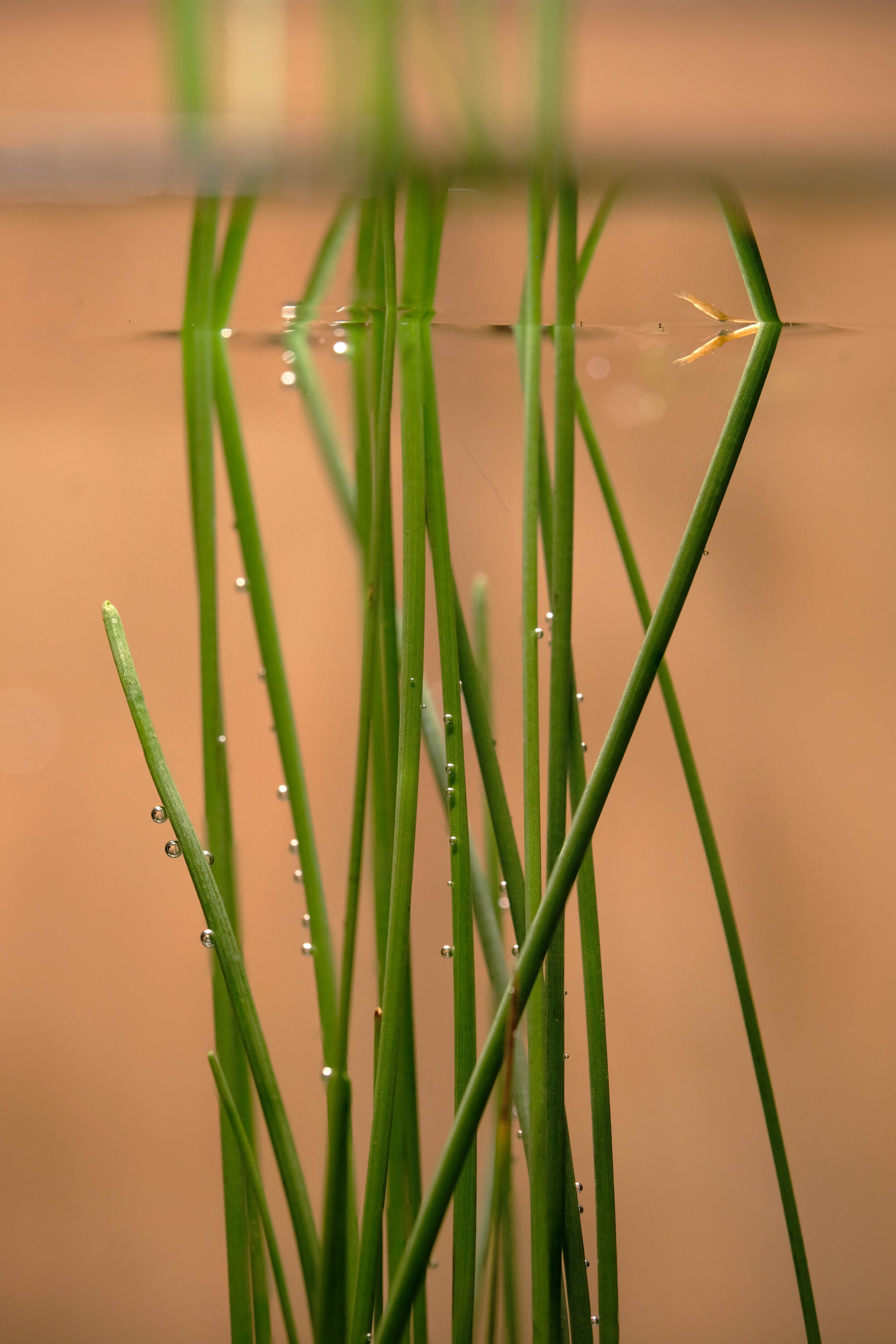
In aquatic environments, plants fight for light and carbon to maintain photosynthetic activity. Since CO2 is often limited in fresh waters, many species have developed alternative carbon resources. Many plants have partial terrestrial life forms, such as floating leaves or above water growth, and thereby have access to atmospheric CO2. Others, like these green Stoneworts, are able to use bicarbonate HCO3- as a carbon-source.

The fast-growing watereed Elodea nuttallii is capable of utilizing bicarbonate in photosynthesis.

The fast-growing watereed Elodea nuttallii is capable of utilizing bicarbonate in photosynthesis.

Moreover, rapid photosynthesis can reduce CO2 in water substantially below air saturation. In response to frequent CO2limitations, many aquatic plants have developed carbon concentrating mechanisms via the use of bicarbonate (HCO3‑). Bicarbonate availability is a product of catchment geology and geological history and largely decoupled from present day climate. Consequently, if carbon uptake strategies in aquatic plants are linked to bicarbonate concentrations it might present an environmental link contrasting plant growth in terrestrial plants.

In this study we used a range of data sources to document the global distribution of bicarbonate uptake in aquatic plants. Using photosynthesis trait information from ~130 species, representing ~10% of the known species pool, we were able to establish a global link between bicarbonate concentrations and bicarbonate uptake in aquatic plants. At a global scale, the proportion of study species utilizing bicarbonate increased with increasing bicarbonate concentrations (this correlation persisted when adjusting for climate differences between regions).

Aquatic plants ability to use bicarbonate as a carbon source are positively correlated with bicarbonate concentrations. The map shows some interesting patterns with low concentrations in major outwash zones (big river catchments and postglacial melt…

Aquatic plants ability to use bicarbonate as a carbon source are positively correlated with bicarbonate concentrations. The map shows some interesting patterns with low concentrations in major outwash zones (big river catchments and postglacial melt zones).

However, at regional scales seemingly different factors could create this pattern. Using 967 northern hemisphere lakes and streams we showed that the global environment-trait relationship was habitat-dependent. In lakes, which often undergo CO2 limitations, bicarbonate use did increase with increasing bicarbonate and decreasing CO2concentrations. In streams, the presence of the trait changed independently of bicarbonate, but decreased with CO2 concentrations. Together this suggest that a pure CO2 strategy is only maintained in environments with stable and high rates of CO2 available.

Photosynthesis strategies along bicarbonate gradients in northern hemisphere aquatic plant communities. Due to inflow of CO2-rich water streams rarely experience CO2 depletions and bicarbonate use are only selected towards when at low CO2 concentrat…

Photosynthesis strategies along bicarbonate gradients in northern hemisphere aquatic plant communities. Due to inflow of CO2-rich water streams rarely experience CO2 depletions and bicarbonate use are only selected towards when at low CO2 concentrations (e.g. in downriver stretches). Lakes often experience CO2 depletions and bicarbonate use show a high response to increasing bicarbonate concentrations.

7_iversen.jpg

Altogether, we provide important inputs to a general model for plant growth and distributions in aquatic plant. Our results can explain the systematic change in lake ecosystems following acid rain in the northern hemisphere during the 1970s and 1980s and predict how these lakes will respond to the present days recalcification trends. Among terrestrial plants, the evolution of leaf traits and different photosynthetic pathways that enables rapid carbon assimilation and improved water economy has resulted in global biogeographical patterns that are linked to variations in climate. In contrast, for freshwater plants, we show that biogeographical patterns of bicarbonate-use exist and that these are caused by catchment properties that determine the concentration of bicarbonate and CO2. This insight will help evaluate the repercussions of future changes in concentration of bicarbonate and CO2 on the biodiversity and ecosystem function for fresh waters.

Read the full paper here.

And a perspective written by Rafael Marcé and Biel Obrador here

Citations:

Iversen L. L., Winkel A., Baastrup-Spohr L., Hinke A. B., Alahuhta J., Baattrup-Pedersen A., Birk S., Brodersen P., Chambers P A., Ecke F., Feldmann T., Gebler D., Heino J., Jespersen T S., Moe S J., Riis T., Sass L., Vestergaard O., Maberly S C., Sand-Jensen K., & Pedersen O. (2019): Catchment properties and the photosynthetic trait composition of freshwater plant communities. Science DOI 10.1126/science.aay5945.

Time is running out for sand

Lars Iversen

Screenshot 2019-08-01 at 14.21.26.png
Bangladesh+India+Site_+TEST+edited.jpg

Mette and I had a commentary article out in Nature last month. Here we argue that there is an urgent need for a global agenda for sand. The paper is promoted via globalsand.org which we plan to develop into a global hub for future research on sand shortage.

Rapid urbanization and global population growth have fueled the demand for sand and gravel, with between 32 and 50 billion tons extracted globally each year, and both consumption and prices are expected to rise further. Consequently, we are now starting to exhaust a resource that many people often consider infinite.

In the article we discuss how research must adopt a holistic approach, not only focusing on issues such as the amount of sediment held back in reservoirs, and the effects of changing riverine water and sediment flux in a warming climate, but also take into account the sediment removed through sand mining. New technologies are, at last, enabling us to see the realistic goal of a global sediment monitoring network: what is required now is the political will and finance to put this in place. Furthermore, the full range of anthropogenic impacts on the world’s rivers, and their potentially nonlinear interactions, must be incorporated into estimates of global sediment fluxes. The issue of sand scarcity cannot be studied in geographical isolation as it has worldwide implications and the reality and size of the problem must be acknowledged, and action taken, on a global stage. In a rapidly changing world, we cannot afford blind spots.

fade copy.jpg

Although the paper is targeting a general audience it has sparked several promising ideas for future research on sand mining in the world big rivers.

Mette is highlighting our paper in the most recent Nature podcast, starting at 10:48.

Bendixen M., Best J., Hackney C., & Iversen L.L. (2019): Time is running out for sand. Nature. DOI: 10.1038/d41586-019-02042-4. https://www.nature.com/articles/d41586-019-02042-4

Melting Greenland Is Awash in Sand. New York Times (Jul 1 2019) – https://www.nytimes.com/interactive/2019/07/01/climate/greenland-glacier-melti

Melting Greenland Is Awash in Sand. New York Times (Jul 1 2019) – https://www.nytimes.com/interactive/2019/07/01/climate/greenland-glacier-melti