contact us

Use the form on the right to contact us.

You can edit the text in this area, and change where the contact form on the right submits to, by entering edit mode using the modes on the bottom right.

Form Block
This form needs a storage option. Double-click here to edit this form, and tell us where to save form submissions in the Storage tab. Learn more
         

123 Street Avenue, City Town, 99999

(123) 555-6789

email@address.com


You can set your address, phone number, email and site description in the settings tab.
Link to read me page with more information.

STORIES

Welcome to the homepage of Lars L. Iversen - Freshwater kid and PhD Fellow from Copenhagen, Denmark,
 

Thoughts about Greenland's unexpected natural resources.

Lars Iversen

This week in Science Mette, Irina, and I highlight some of the recent advances in the understanding of fluvial deposits along the coast of Greenland and how this could be an otherwise unknown sand source to the global market.

With this comment, we propose that sand-extraction in selected sites in Greenland could contribute to the global need for sand while developing the national economy and strengthen Greenland’s independency from Danish subsidies.

It should be stressed that If Greenland is to benefit from sand extraction, we must raise awareness about the resource both locally and globally, the Greenlandic people must learn best practices to extract the sand, and the industry must guarantee that extraction methods minimize potential negative impacts on the local environment.

  
  96


  Normal
  0


  false
  false
  false
  
  EN-US
  X-NONE
  X-NONE


&n…

Greenland's rivers alone deliver 8 % of the global budget of fluvial transported suspended sediments. @Nicolaj Krog Larsen

Delta evolution in Greenland

Lars Iversen

Two weeks ago, I had the great fortune to publish a paper in nature together with a team of amazing cryosphere scientists.

The study system during the last two years. The delta plain, the hinterlands and the surrounding ocean @Nikolaj Krog Larsen.

The study system during the last two years. The delta plain, the hinterlands and the surrounding ocean @Nikolaj Krog Larsen.

The paper is freely available here

In the study, we show that deltas in the southern half of Greenland have grown over the past few decades, following a period of stability in the mid-twentieth century. Furthermore, we tie these delta expansions to periods of reduced sea ice and increased melt from the Greenland Ice Sheet. Throughout the Arctic, coasts have shown erosional trends, and deltas in particular, are known to drown all over the globe – Our results are interestingly showing, that as a consequence of climate change and increased run-off from the glaciers and ice sheet, Greenlandic deltas are growing.


The study started as dinner conversations between Mette and I where we discussed some of Mette’s recent delta work on the island of Disko at the west coast of Greenland (Bendixen & Kroon 2017 ESPL). In the beginning, it was most about potential fun applications of different non-parametric models but quickly turned into the ambition of upscaling the study from Disko.

g_photocredit_Styrelsen_for_Dataforsyning og_Effektivisering.jpg
f_photocredit_Styrelsen_for_Dataforsyning og_Effektivisering.jpg

Crucial was the realization that open sources images from Google Earth could be binned to an archive of historical aerial images from the 1980s. Images stored in a large archive at the Geo-data agency in Copenhagen together with other image archives from the 1940s and 1960s. From thereof the project did grow step by step and thanks to the incredible hard work of Mette and the other co-authors we have been able to place rapid changes of the Greenlandic landscape in the global spotlight

Working on the first resubmission.

Working on the first resubmission.

Second resubmission.

Second resubmission.

Personally, the project has been a first encounter with arctic research. Although I’m not a geologist, nor will I ever be, it’s been extremely rewarding to work with strict landscape patterns (no ecology...). Of course, the project has produced more questions than answers and a cascade of interesting spinoffs is now emerging. So, more exiting arctic research to come!


Atlas of the European dragonflies and damselflies

Lars Iversen

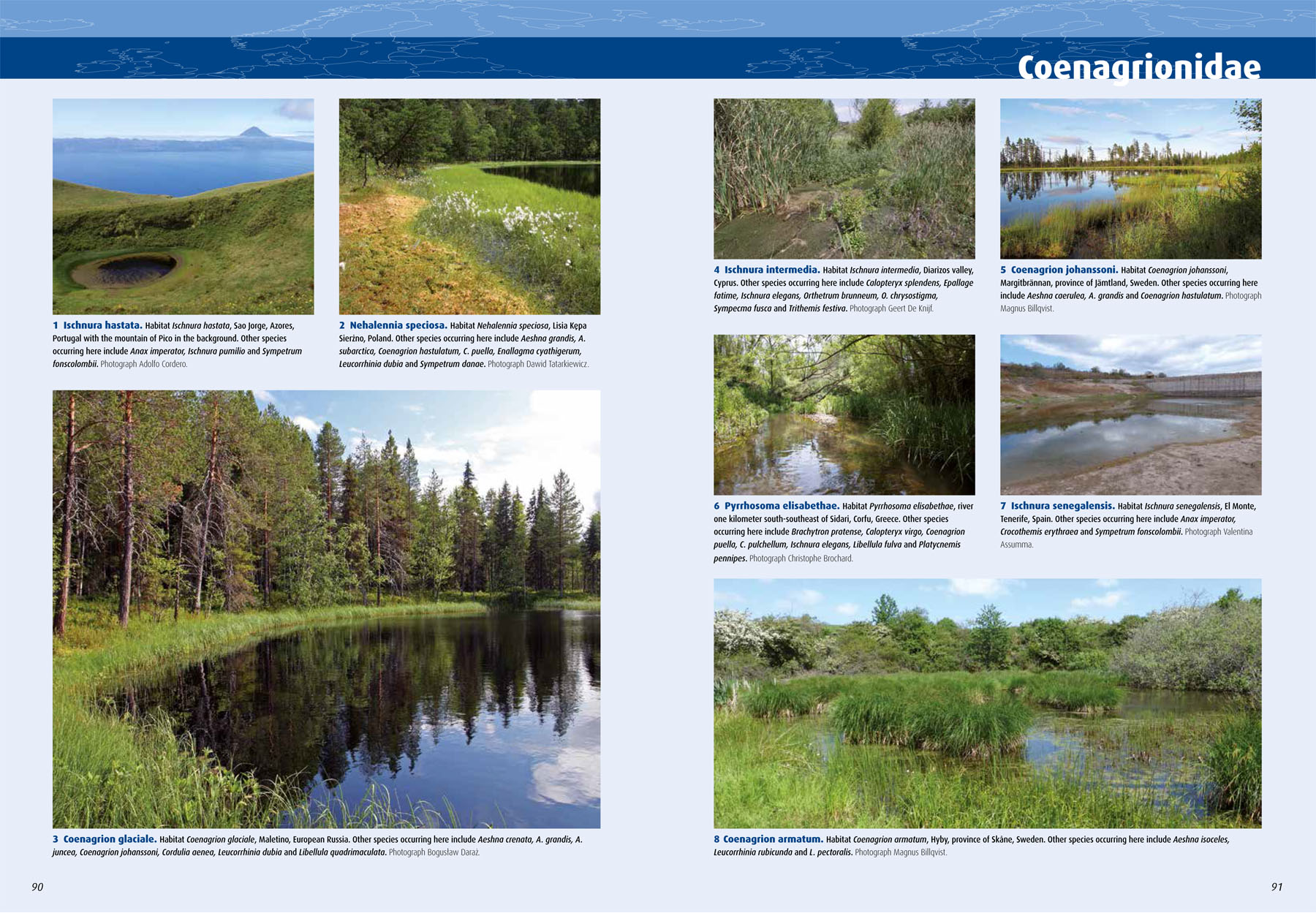
During the past decade over fifty European odonatologist have been co-operating to bring together all published and unpublished distribution records of the 143 European species of dragonflies and damselflies. The results of this endeavor will appear December 2015 in the Atlas European dragonflies and damselflies.

This is the first detailed and complete overview of the distribution of the dragonflies and damselflies of Europe. The book includes over 200 distribution maps showing both the European and global distribution of the species. Further included is information on taxonomy, range, population trends, flights season-, habitat, photos of nearly all species and for each country an overview of the history of odonatological studies.

The work was coordinated by Jean-Pierre Boudot and Vincent Kalkman and together with Erland Refling Nielsen, I contributed with the Danish database and supported some of the chapters in the book. The main part of the data collection was done way back in 2009 when I was still a BSc student. It’s really great to finally see the result of all the hours spend in the museum collections in print.  

9789050114806_0.jpg